《10到25岁》第一章(3):一场科学革命和父母唠叨研究
说明:我正在连载《10到25岁》这本书的原文和翻译。本文是第一章的第3篇。到目前为止,原文的结构
- 介绍
- 第一部分:理解10到25岁的年轻人
- 第一章:我们为啥错了
- 第一章(1):花费巨大但效果堪忧甚至反转的干预年轻人的两个项目
- 第一章(2):对神经生物学无能模型的质疑和真相运动
- 本文在这里:一场科学革命和父母唠叨研究
A Scientific Revolution 一场科学革命
Dr. Ron Dahl is one of the leading minds in the science of adolescence. He may be in his midfifties, but he acts young at heart—-brimming with energy, and daring to raise big questions that nobody else would touch, a lot like the adolescents he specializes in. Dahl has spent decades conducting research on the basic workings of the adolescent brain. But he can hardly keep himself from bouncing from human neuroscience to animal research on puberty to the cultural anthropology of adolescence in preindustrial societies to the behavioral experiments in my research. Dahl’s eclectic and driven style of research is partially the result of experiences from his youth. He grew up in a working-class family in Kane, Pennsylvania, over one hundred miles from any major city. His brother went down a tragic path of addiction, but Dahl didn’t. He attributes this in part to the influence of a mentor in high school, his humanities teacher Arlene Heath. She lived and breathed the wise-feedback note, demanding excellence and having vigorous debates with him but always caring for him. For thirty years until she died in her nineties, she wrote him letters to challenge him to think more broadly, beyond the boundaries of science, and to ask the bigger questions about what it means to be human. Dahl dislikes the negative incompetence view of adolescence in part because he knows how young people can be inspired and empowered by mentors like Arlene.
罗恩·达尔博士是青少年科学领域的领军人物之一。尽管他已经五十多岁,但心态却非常年轻——充满活力,敢于提出别人不敢触及的大问题,很像他专门研究的青少年。达尔几十年来一直在研究青少年大脑的基本运作机制。但他几乎无法控制自己从人类神经科学跳到动物青春期研究,再到前工业社会青少年文化人类学,再到我的研究中的行为实验。达尔这种多元且执着的研究风格部分源于他年轻时的经历。他在宾夕法尼亚州凯恩的一个工薪阶层家庭长大,距离任何大城市都超过一百英里。他的兄弟走上了吸毒的悲剧道路,但达尔没有。他将这部分归因于高中时一位导师的影响,他的文科老师阿琳·希思。她全身心投入,使用智慧反馈策略,要求卓越,与他进行严肃的讨论,但始终关心他。在她九十多岁去世前的三十年里,她一直给他写信,挑战他更广泛地思考,超越科学的边界,提出关于人之为人的更大问题。达尔不喜欢青少年无能的看法,部分原因是他知道年轻人可以通过像阿琳这样的导师获得启发和赋能。
Dahl cofounded the Center for the Developing Adolescent with colleagues like Dr. Adriana Galvan at UCLA to spread a more accurate—and optimistic—science of adolescence. (I am a member of the center’s scientific steering committee.) Dahl, Galvan, and the rest of the scientists at the Center for the Developing Adolescent are on a mission to explain why the neurobiological-incompetence model is wrong —and how to use this more accurate view of youth to better society.
达尔与加州大学洛杉矶分校的同事如阿德里安娜·加尔万博士共同创立了青少年发展中心,以传播更准确且乐观的青少年科学。(我是该中心科学指导委员会的成员。)达尔、加尔万以及青少年发展中心的其余科学家们致力于解释为什么神经生物学无能模型是错误的——以及如何利用这种更准确的青少年观点来改善社会。
According to the incompetence model, young people’s brains are incapable of correctly weighing the future consequences of their behaviors—such as how an impulsive action now could lead to poorer health later. In this model, young people lack working prefrontal cortices, which is the part of the brain that controls planning. What’s more, their brains are swimming in hormones that make them impulsive and ready to jump on any short-term pleasure or avoid any short-term pain, regardless of the long-term consequences. Young people’s feeble prefrontal cortices, according to the incompetence model, are no match for their appetites for reward. A popular metaphor for this model suggests that young people are driving a car that’s “all gas” (a hormone-induced, neural impulse for reward) with “no brakes” (lacking a reasonable brain that can stop the impulse). Due to this supposed lack of a prefrontal cortex, it’s unwise to ask young people to make consequential decisions that could affect their future.
根据无能模型,年轻人的大脑无法正确权衡其行为未来的后果——比如冲动的行为现在可能导致以后健康状况恶化。在这个模型中,年轻人缺乏工作的前额叶皮层,这是控制计划的大脑部分。更重要的是,他们的大脑中充满了激素,使他们冲动,随时准备追求任何短期快乐或避免任何短期痛苦,而不顾长期后果。根据无能模型,年轻人脆弱的前额叶皮层无法抵挡他们对奖励的渴望。一个流行的隐喻表明,年轻人驾驶的是一辆“全油门”(激素诱导的神经冲动追求奖励)而“无刹车”(缺乏一个能阻止冲动的合理大脑)的汽车。由于这种所谓的前额叶皮层不足,要求年轻人做出可能影响他们未来的重大决策是不明智的。
The incompetence model has ancient roots. Plato wrote in the Phaedrus in the fourth century BCE that the process of transitioning from youth into mature adulthood is like a charioteer struggling to control two powerful winged horses, like Pegasus. In this metaphor, the charioteer represents our reason or logic, and the unruly horses our passions. According to Plato, we must learn to discipline and suppress our youthful passions, and only then can we ascend to the heavens and see what is true, good, and beautiful. The basic contours of Plato’s argument persisted for centuries and were later adopted by neuroscientists. By the turn of the twenty- first century, our prefrontal cortices took the place of the charioteer and our limbic systems symbolized the unruly team of horses to be controlled. “The prefrontal [cortex] became the aspiration for how adolescents should develop,” Galvan told me.
无能模型有着古老的根源。柏拉图在公元前四世纪的《费德罗篇》中写道,从青少年过渡到成熟成人的过程就像一个战车驭手努力控制两匹强大的有翼马,像珀加索斯一样。在这个隐喻中,战车驭手代表我们的理性和逻辑,而难以驾驭的马代表我们的激情。根据柏拉图的说法,我们必须学会约束和抑制我们年轻时的激情,只有这样我们才能升入天堂,看到什么是真实、善良和美丽的。柏拉图论点的基本轮廓延续了几百年,后来被神经科学家采纳。到二十一世纪初,我们的前额叶皮层取代了战车驭手,而我们的边缘系统象征着一群需要控制的难以驾驭的马。“前额叶皮层成为了青少年应该如何发展的期望,”加尔万告诉我。
A key actor in this intellectual history was the MacArthur Foundation Network on Adolescent Development and Juvenile Justice. Started in 1995 and continuing until 2017, this was a network of leading neuroscientists, developmental scientists, and legal scholars. They were brought together for a noble purpose. They aimed to reverse a trend, started in the 1990s, toward increasingly harsh and punitive sentencing for severe crimes committed by youth under eighteen, such as the death penalty or life without parole. Such sentences rested on an assumption that the adolescent’s brain would not continue to mature later in adulthood. The MacArthur network argued that the adolescent brain was still maturing and that irreversible punishments (e.g., the death penalty or life without parole) should not apply to teenagers because they should be withheld for people who are fully responsible for their actions. The network’s research explained how “adolescent immaturity in higher-order executive functions such as impulse control, planning ahead and risk avoidance” was no match for the emotional, impulsive reward- sensitive regions of the brain. A 2012 Supreme Court amicus curiae brief summarizing the network’s research described the “relative deficit in mature self- control” among young people and concluded that “expecting the experience-based ability to resist impulses… to be fully formed prior to age eighteen or nineteen would seem on present evidence to be wishful thinking.” With this evidence, the MacArthur network successfully lobbied the Supreme Court to change federal policy about sentencing juveniles to the death penalty and later life without parole, first in 2005 (Roper v. Simmons), then in 2010 (Graham v. Florida), and later in 2012 (Miller v. Alabama). The neurobiological-incompetence model, therefore, could be used for good, even though it wasn’t the whole story.
在这一思想史上的关键角色是麦克阿瑟基金会支持的研究青少年发展与少年司法的网络。该网络始于1995年,持续到2017年,汇集了领先的神经科学家、发展科学家和法律学者。他们因一个高尚的目的而聚集在一起。他们旨在扭转20世纪90年代开始的趋势,即对18岁以下青少年犯下的严重罪行进行越来越严厉和惩罚性的判决,如死刑或无期徒刑。这类判决基于一个假设,即青少年的大脑在成年后期不会继续成熟。麦克阿瑟网络认为,青少年大脑仍在成熟,不可逆的惩罚(例如死刑或无期徒刑)不应适用于青少年,因为这类惩罚应保留给完全对其行为负责的人。该网络的研究解释了“青少年在高级执行功能如冲动控制、提前计划和风险规避方面的不成熟”如何无法与大脑中情绪化、冲动的奖励敏感区域相匹配。2012年最高法院的法庭之友简报总结了该网络的研究,描述了年轻人中“成熟自我控制的相对缺陷”,并得出结论:“期望基于经验的抵抗冲动的能力在十八九岁之前完全形成,根据现有证据似乎是一种一厢情愿的想法。”凭借这些证据,麦克阿瑟网络成功游说最高法院改变关于对青少年判处死刑和后来无期徒刑的联邦政策,首先在2005年(罗珀诉西蒙斯案),然后在2010年(格雷厄姆诉佛罗里达州案),再后来在2012年(米勒诉阿拉巴马州案)。因此,神经生物学无能模型可以被用于善的目的,尽管它并非全部真相。
The MacArthur network’s take on the adolescent brain soon spread beyond the narrow use case of adolescent criminal sentencing. It was applied to any and every youth decision-making process. One kidney transplant doctor I talked to heard a presentation on the network’s research. He soon concluded that asking an adolescent to use their prefrontal cortex to remember to take their immunosuppressants “is like asking someone without triceps to do pushups—it’s impossible.” Outside of the legal context, the incompetence model urges adults to try to take control of young people since we can’t trust their judgment. The same kidney doctor joked that we should just implant a chip in young patients’ brains to remind them to take their meds, and shock them if they don’t, to make up for the hole where their prefrontal cortex is supposed to be. That’s the incompetence model taken to its logical conclusion.
麦克阿瑟网络对青少年大脑的看法很快超出了青少年刑事判决的狭隘应用范围。它被应用于任何和所有的青少年决策过程。我与一位肾脏移植医生交谈,他听了一场关于该网络研究的演讲。他很快得出结论,要求青少年使用他们的前额叶皮层来记住服用他们的免疫抑制剂“就像要求一个没有三头肌的人做俯卧撑——这是不可能的。”在法律语境之外,无能模型敦促成年人试图控制年轻人,因为我们不能信任他们的判断。同一位肾脏医生开玩笑说,我们应该在年轻患者的脑中植入一个芯片来提醒他们服药,如果他们不服用就电击他们,以弥补他们前额叶皮层应有的空白。这就是基于无能模型的逻辑推导的结论。
Was the MacArthur network’s incompetence model founded on solid evidence? One key study in support of it came from none other than Adriana Galvan. In Galvan’s well-known 2006 study, she and her colleagues scanned the brain activity of thirty-six children, adolescents, and adults as they made gambles to get small, medium, or large financial rewards. When the adolescents won large rewards, the reward-sensitivity regions of their brains lit up more than any other age group. The region of the brain implicated in planning for the future (the prefrontal cortex) didn’t show the same activation. This finding has taken on a legendary status in the field. It seemed to show a maturational imbalance in which the adolescent brain is hijacked by a lust for rewards to the detriment of the rational, temperate parts of the brain. Galvan stands by the study’s results but no longer thinks the field has interpreted them correctly. Her study didn’t show that adolescents have a puberty-induced frontal lobotomy. “Of course adolescents have prefrontal cortices,” Galvan told me. The prefrontal cortex helps you with goal-directed behavior, “and young people are really good at goal-directed behavior.”
麦克阿瑟网络的无能模型是否建立在坚实的证据之上?支持该模型的一项关键研究正是出自阿德里安娜·加尔万之手。在加尔万2006年的一项著名研究中,她和她的同事们扫描了36名儿童、青少年和成年人在进行小额、中额或大额财务奖励赌博时的大脑活动。当青少年赢得大额奖励时,他们大脑中与奖励敏感相关的区域比其他任何年龄组都更加活跃。与未来规划相关的大脑区域(前额叶皮层)却没有显示出同样的激活。这一发现在该领域具有传奇地位。它似乎显示了一种成熟不平衡,即青少年大脑被对奖励的渴望所劫持,损害了理性、温和的大脑部分。加尔万坚持该研究的结果,但不再认为这一结果被正确解读。她的研究并没有表明因青春期导致的前额叶消失。“当然,青少年有前额叶皮层,”加尔万告诉我。前额叶皮层帮助你进行目标导向行为,“而年轻人非常擅长目标导向行为。”
Think about it. Young people do lots of complex things—they learn calculus, they become elite athletes and compete in the Olympics, they figure out how to get their crushes to fall in love with them, and they master new trends, technologies, and programming languages months or years before adults. These skills require functioning prefrontal cortices. Even “deviant” behavior takes planning. Do you remember making plans to sneak out, organize a house party, or hide something from your parents? If you were like most teens, you were like Patton in the European theater. Likewise, teens who smoke must clear many logistical hurdles. They need to own and remember a lighter; they have to convince a twenty-one-year-old to buy them cigarettes; they have to hide the evidence, wash the scent out of their clothes, and more. These accomplishments—good and bad—would be impossible without a functioning prefrontal cortex.
想想看。年轻人做很多复杂的事情——他们学习微积分,他们成为精英运动员并参加奥运会,他们想办法让他们的暗恋对象爱上他们,他们比成年人早几个月或几年掌握新趋势、技术和编程语言。这些技能需要功能正常的前额叶皮层。即使是“偏差”行为也需要计划。你还记得制定计划偷偷溜出去、组织家庭聚会或对父母隐瞒某事的情景吗?如果你像大多数青少年一样,你就像在欧洲战场的巴顿将军。同样,吸烟的青少年必须克服许多后勤障碍。他们需要拥有并记住打火机;他们必须说服一个21岁的人为他们买香烟;他们必须隐藏证据,洗掉衣服上的气味,等等。这些成就——好的和坏的——如果没有功能正常的前额叶皮层是不可能实现的。
In newer laboratory experiments, Galvan explained, young people often do better at goal-directed behavior than adults, when incentive structures are right. “They’re not always deploying their prefrontal cortices in ways that adults want them to,” Galvan explained, “because they’ve got different motivational priorities.” Specifically, young people value social rewards—experiences like status and respect—from both peers and adults. When they sense that their social status and respect are under threat, or when they see a route to feeling more like socially valuable people, then they switch what they pay attention to more rapidly than adults do later in life. These newer studies made this discovery in part because they broadened their view of what a reward is. Foundational studies like Galvan’s in the early 2000s involved a financial gamble as a reward when the participants were humans. When the participants were rats or hamsters they involved hedonic rewards such as sugar water or cocaine. Hedonic rewards are very different from complex social emotions such as pride, belonging, shame, or humiliation. Once neuroscientists (including Galvan’s students) started experimenting with social rewards, then a far more complex pattern of evidence began to emerge. Ultimately it showed important prefrontal abilities in adolescents who were properly motivated.
在新的实验室实验中,加尔万解释说,当激励结构合适时,年轻人在目标导向行为上往往比成年人做得更好。“他们并不总是以成年人希望的方式使用他们的前额叶皮层,”加尔万解释道,“因为他们有不同的动机优先级。”具体来说,年轻人重视来自同龄人和成年人的社会激励——如地位和尊重等。当他们感觉到自己的社会地位和尊重受到威胁,或者当他们看到一条让自己感觉对社会更有价值的途径时,他们会比成年后的自己更快地切换他们的注意力。这些新研究得出这一新的发现,部分是因为他们拓宽了激励这个词的外延。像加尔万在2000年代初的奠基性研究中,激励与金钱赌博相关,当时参与者是人类。当参与者是老鼠或仓鼠时,他们采用的是享乐激励,如糖水或可卡因。享乐激励与骄傲、归属、羞耻或羞辱等复杂社会情感非常不同。一旦神经科学家(包括加尔万的学生)开始用社会激励进行实验,一个更为复杂的证据模式就开始显现。最终,它表明了在适当激励下,青少年重要的前额叶能力。
The Parental-Nagging Study 父母唠叨研究
Kevin is in his early twenties, and he’s on his second kidney transplant. When asked what it’s like to be a teenager needing to take his meds twice daily, he was quick to say that his main memory was of his mom yelling at him. He didn’t like this because he already felt guilty enough. He felt bad that his aunt gave up her kidney for him, and he worried that his expensive medications were a financial burden on his single mother. When his mom told him to do something he already felt guilty about, he said “It feels like an accusation, like a lack of trust.” Did it motivate him to be independent? Take his medications? “Not at all,” he told me.
凯文二十出头,他正在接受第二次肾脏移植。当被问及作为一个青少年需要每天两次服药是什么感觉时,他很快说,他主要的记忆是他妈妈对他大喊大叫。他不喜欢这样,因为他已经感到足够内疚了。他感到难过,因为他的姨妈为他捐了一个肾,他担心他昂贵的药物给他的单亲妈妈带来了经济负担。当他的妈妈告诉他,让她去做他已经感到内疚的事时,他说“这感觉像是一种指责,像是不信任。”这鼓励他独立,且按时服药了吗?“一点也没有,”他告诉我。
Kevin’s experiences were consistent with the results of a study that Ron Dahl published in 2014 with Jennifer Silk and a team of researchers at the University of Pittsburgh. Their landmark study answered a simple yet profound question: What happens in the teenage brain when you’re being nagged by your parents?
凯文的经历与罗恩·达尔在2014年与詹妮弗·希尔克和匹兹堡大学的一组研究人员发表的一项研究的结果一致。他们的里程碑式研究回答了一个简单却深刻的问题:当你的父母对你唠叨时,你的青少年大脑会发生什么?
Silk and her team brought a few dozen healthy boys and girls aged nine to seventeen into the research laboratory to have their brains scanned in a functional magnetic resonance imaging machine, or fMRI. The fMRI is a machine that can detect which parts of your brain are engaged at what time and which parts of your brain are tuning out. (It does this by detecting changes in blood flow in regions that reflect different patterns of neural activity.) The week before the study, the subjects’ mothers recorded themselves completing this sentence: “One thing that bothers me about you is…” The researchers took these clips and played the one for each subject while the fMRI magnet circled their brain. Here’s an example of what a teenager heard from their mom:
One thing that bothers me about you is that you get upset over minor issues. I could tell you to take your shoes from downstairs. You’ll get mad that you have to pick them up and actually walk upstairs and put them in your room. You’ll get mad if I tell you that your room is a little dirty, and it just needs sweeping and dusting. You get upset if your sisters want to do something that you don’t agree on but three of them do, and you don’t want to do it. You get upset too easily, and you just need to calm that down.
希尔克和她的团队带了几十个九到十七岁的健康男孩和女孩进入研究实验室,在功能性磁共振成像仪(fMRI)中进行大脑扫描。fMRI是一种可以检测你大脑的哪些部分在何时被激活以及哪些部分在休息的机器。(其方法是检测各脑区中反映不同神经活动模式的血流量变化。)研究前一周,受试者的母亲自己录制了这句话:“让我烦恼的一件事是……”研究人员将这些录音片段播放给每位受试者,同时使用fMRI磁带环绕他们的大脑。以下是一个青少年从他们妈妈那里听到的话:
让我烦恼的一件事是,你会为一些小事感到不安。我告诉你把鞋子从楼下拿上来。你会因为必须捡起它们并实际走上楼放到你房间而生气。如果我说你的房间有点脏,只需要扫一扫、掸一掸,你也会生气。如果你的姐妹们想做你不同意但她们三个都同意的事,你也会生气。你太容易生气了,你只需要冷静下来。
Imagine that you’re a teenager. Then try reading this out loud. Your hormones are raging. Your mom is constantly on your case. And she says to you, You just need to calm that down. How would you feel? You might feel angry, disrespected, and offended. It diminishes your feelings, telling you that you shouldn’t feel the way you feel. Your mother’s attitude also threatens your autonomy, treating you like a child who just needs to do as they’re told. Young people hate being made to feel like that.
想象你是一个青少年。然后试着大声读出来。你的激素在激增。你妈妈总是对你唠叨。而她对你说,你只需要冷静下来。你感觉怎么样?你可能会感到愤怒、不被尊重和被冒犯。这贬低了你自己的感受,告诉你不应该有你现在的感受。你母亲的态度也威胁到你的自主性,把你当作一个只需要按吩咐做的孩子。年轻人讨厌被那样对待。
What did the brain-activation data show? Silk and Dahl’s team found that during the parental nagging, the regions of the brain that were associated with feeling intense emotions were on fire (more blood flow in the lentiform nucleus and the posterior insula), a neural signature showing that the youth were angry. How about the thinking-and-planning region of the brain (the dorsilateral prefrontal cortex, DLPFC) and the region of the brain related to listening to a speaker and inferring their meaning (the temporoparietal junction, TPJ)? In a perfect world, those regions would be lighting up more, which would signal that the subjects were listening to the criticism, processing it, and planning out how to respond. But the opposite happened. The planning regions of the brain showed dramatically lower activation, suggesting there were no plans to do what the parent said. The “mind- reading” regions (the TPJ) showed lower activation, suggesting the youth weren’t trying to understand what their parents really wanted from them. Thus, the parental nagging triggered no listening or planning how to change—only fury and frustration.
大脑激活数据显示了什么?希尔克和达尔的团队发现,在父母唠叨期间,与强烈情感相关的大脑区域(豆状核和后岛叶)异常活跃,这一神经特征显示年轻人很生气。那么,思考和规划区域的大脑(背外侧前额叶皮层,DLPFC)以及与听说话者并推断其意义相关的大脑区域(颞顶交界处,TPJ)呢?在一个完美的世界里,这些区域会更活跃,这表明受试者在听批评、处理它并计划如何回应。但情况恰恰相反。规划区域的大脑显示出显著较低的激活,表明没有计划去做父母说的。而“读心”区域(TPJ)显示出较低的激活,表明年轻人没有试图理解父母真正想要他们做什么。因此,父母的唠叨触发了年轻人的愤怒和挫败感,而没有倾听或计划如何改变。
Interestingly, the researchers also had the young people in the same study listen to their mothers talk in a more neutral tone. No accusations, no diminishment, no controlling demands. When that happened, the brain scans of the young people looked fine. They took in the information, and their thinking-and-planning brain regions were engaged. That is, their brains performed competently when their mothers talked to them neutrally. This is not the data you would see if their brains were biologically deficient. Instead, these are the results you’d expect to see if young people are highly responsive to whether adults speak to them disrespectfully.
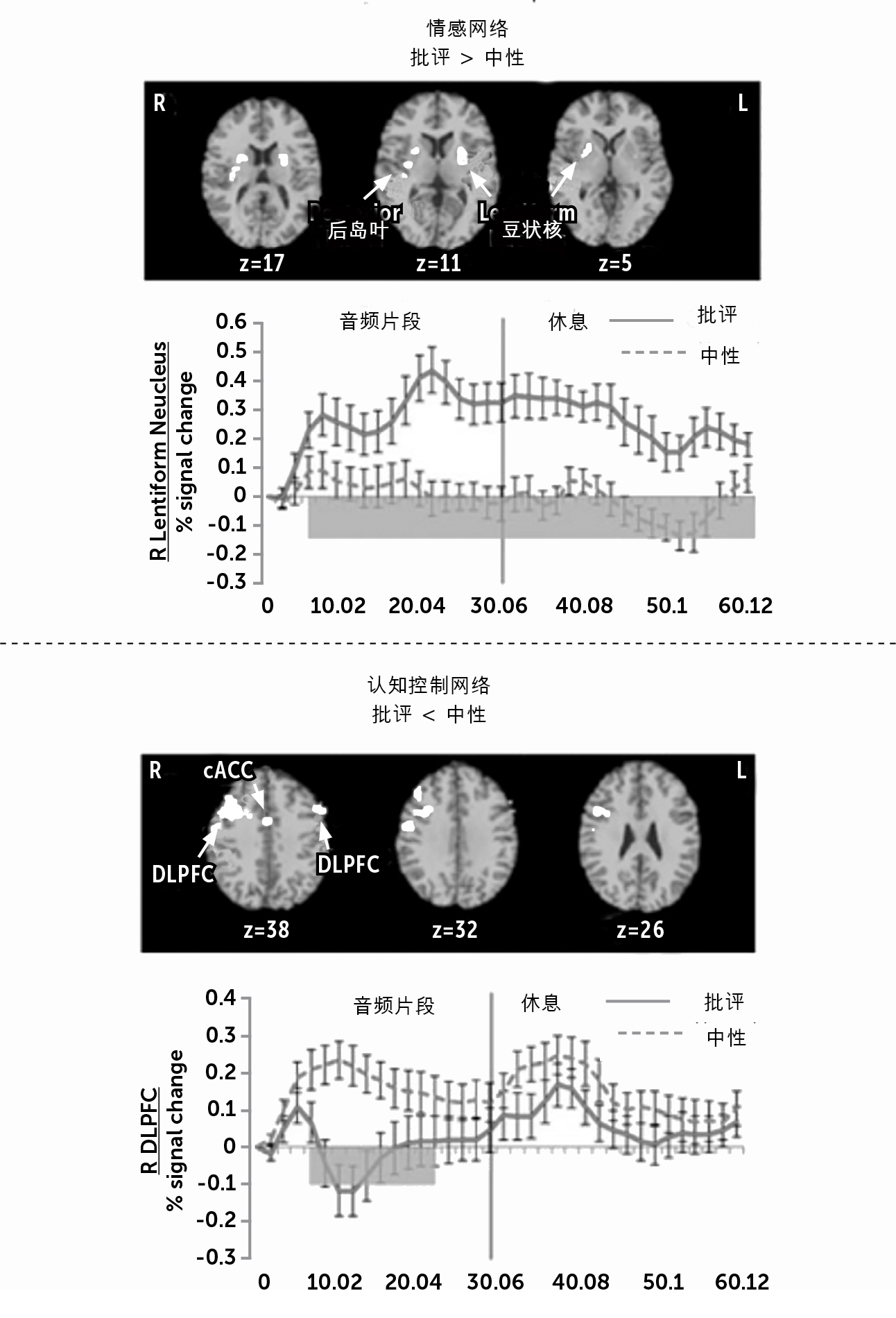
有趣的是,研究人员还让同一研究中的年轻人在更中性的语气下听他们的母亲说话。没有指责,没有贬低,没有控制性的要求。当这种情况发生时,年轻人的大脑扫描看起来很好。他们接受了信息,他们的大脑思考和规划区域被激活。也就是说,当他们的母亲以中立的态度与他们交谈时,他们的大脑表现出了能力。这不是你会在他们大脑生物学上存在缺陷时看到的数据。相反,这是你会在年轻人对成年人是否以不尊重的方式与他们交谈高度敏感时看到的结果。